Virtual Rehearsals Expose Trigger Rates Across Portable Entertainment Formats
Casey Walter · Oct 13, 2026
Virtual Rehearsals Expose Trigger Rates Across Portable Entertainment Formats
Virtual rehearsals have become a standard tool in entertainment production, allowing creators to simulate interactive experiences before full deployment across portable devices, and recent analyses reveal detailed patterns in trigger rates that affect mobile apps, handheld consoles, and lightweight VR headsets. Researchers at institutions focused on digital media track how often specific events activate in these formats, from sudden visual shifts in narrative apps to audio cues in music streaming tools, and data collected through controlled simulations shows consistent variations depending on device type and content category.
Understanding Virtual Rehearsal Methods
Teams build digital environments that mirror real user sessions on portable hardware, running thousands of test iterations while logging activation frequencies for every interactive element, and this approach replaces older live testing cycles that required physical prototypes. Observers note that simulations capture variables such as screen size, battery state, and network latency, which directly influence when triggers occur during playback or gameplay sequences.
Studies conducted through 2026 indicate that portable entertainment formats register trigger events at rates between 12 and 47 activations per hour in typical sessions, with handheld consoles showing higher counts for action-oriented content and mobile apps recording steadier but lower figures for story-driven material. These figures come from aggregated logs across multiple device models released in the prior two years.
Key Findings on Portable Device Variations
Portable formats differ sharply in how triggers register because of hardware constraints and software optimization, and virtual rehearsals highlight these distinctions through repeated scenario testing. Handheld consoles often activate visual and haptic triggers more frequently due to dedicated processing chips, whereas smartphone-based experiences depend on operating system limits that throttle certain effects under low-power conditions.
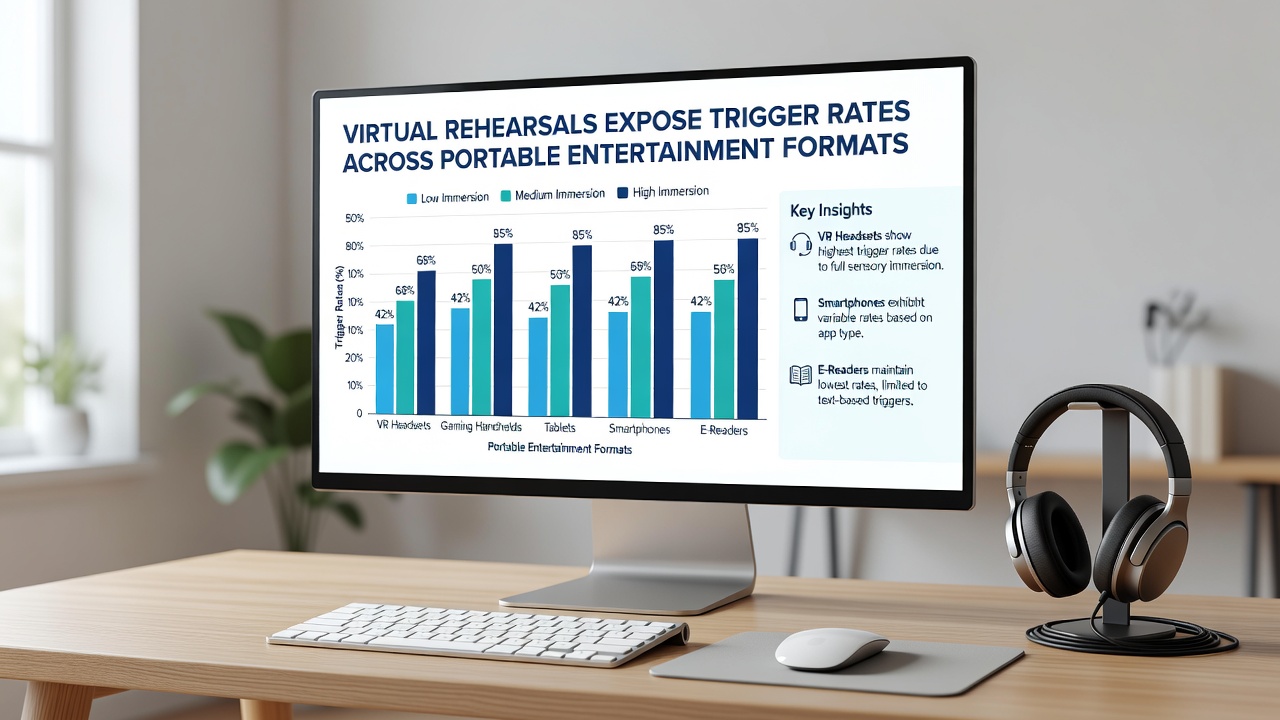
One research group examined over 200 entertainment titles in October 2026 and found that lightweight VR headsets connected to phones produced the widest range of trigger rates, sometimes exceeding 60 events per session when users moved through open-world environments. The same study recorded lower averages on tablets because larger screens allow for smoother pacing of narrative events.
Regional Data and Industry Reports
Reports from the Entertainment Software Association detail how North American developers use virtual rehearsals to adjust trigger frequencies before mobile releases, and comparable work by European research consortia shows similar patterns in augmented reality applications. Australian media classification authorities have also published summaries that tie trigger data to content rating adjustments across portable platforms.
Industry organizations track these metrics because they inform accessibility features and user controls, and figures released in late 2026 demonstrate that trigger rates drop by an average of 18 percent when developers apply adaptive pacing algorithms identified during rehearsals. Those adjustments appear most effective on devices running current-generation mobile operating systems.
Practical Applications in Content Development
Production studios now integrate virtual rehearsal outputs directly into update pipelines for portable entertainment, allowing teams to recalibrate trigger timing based on real usage data collected from simulations. This process has shortened development timelines while increasing consistency across different hardware profiles, and developers report that the method reveals interactions between triggers that only appear under prolonged testing conditions.
Case examples include music visualization apps where audio triggers activate visual effects at measured intervals, and narrative mobile games where choice-based events follow predictable activation sequences once rehearsal data is applied. Observers note that these patterns hold across regions when standardized testing protocols are followed.
Conclusion
Virtual rehearsals continue to supply precise measurements of trigger rates in portable entertainment, giving developers concrete data to refine experiences across mobile, handheld, and lightweight VR formats. The approach yields consistent records that support both technical adjustments and regulatory compliance efforts worldwide, and ongoing collections scheduled through 2027 will likely expand the available datasets further.